

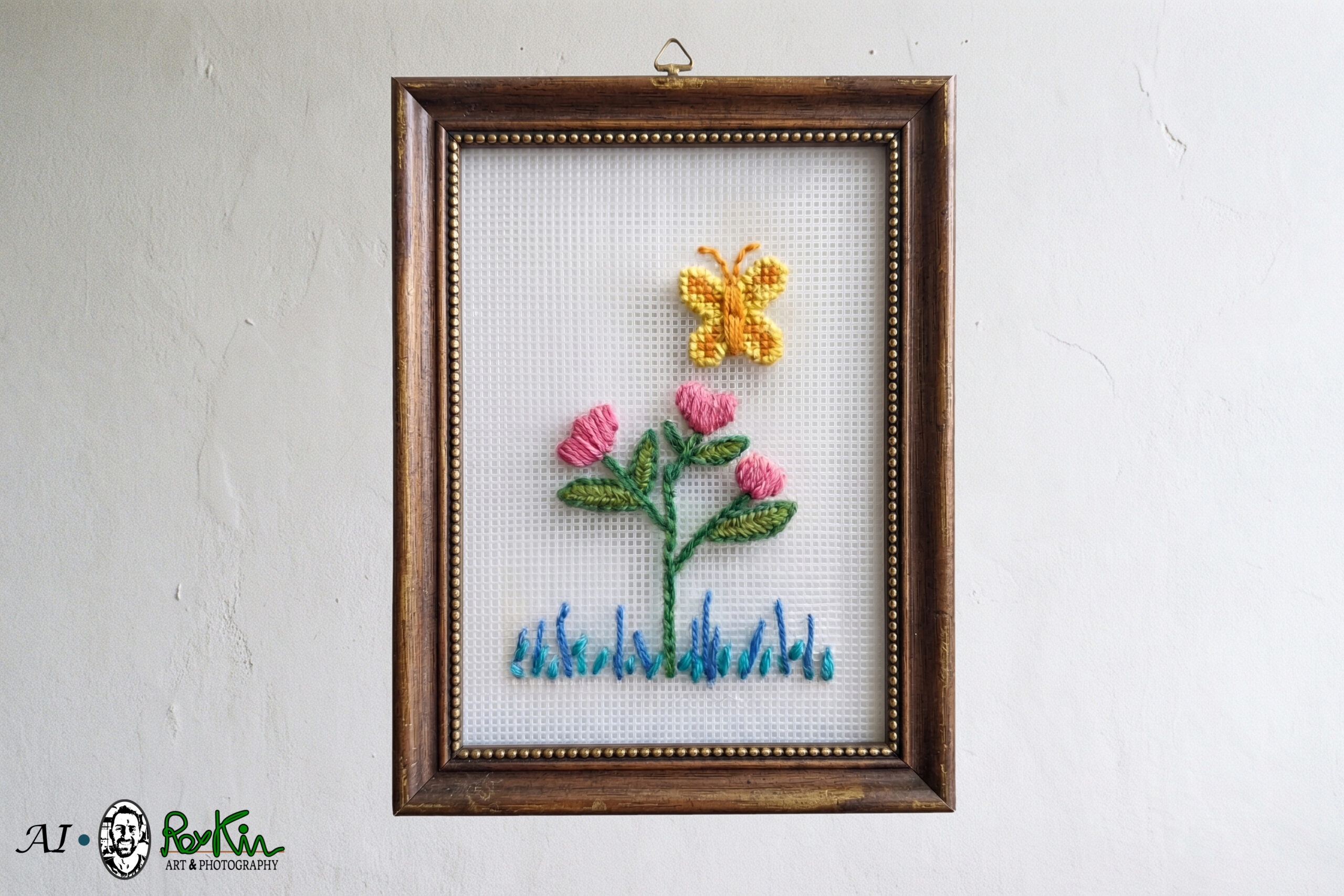
| Date: | September 8, 2026. |
| Technique: | AI: Yarn on Stiff Plastic Canvas Mesh. |
| Dimensions: | N/A. |
| Style: | Digital (AI) Art. |
| Source: | Imagination inspired by old “boyhood memory”. |
|
Creativity:
|

|
Objectives: |

I pursued every conceivable avenue, exhausting every measure to track down my mother’s embroideries—searching through the landscapes of “boyhood memory” (“בּוֹידֶעם”), leaving no stone unturned in my search for a surviving trace of my mother’s embroideries.
I combed through archival records and family photo albums, reviewed my own preservation projects, and most recently, meticulously scoured the closets, drawers, and hidden corners of my parents’ house. Regrettably, despite all this, no physical evidence or material trace remained.
Because every inquiry into the actual works yielded a dead end, this piece has been summoned entirely from the realm of imagination. It is guided solely by a fragile, lingering childhood memory of one of her embroideries—a piece that once graced the wall of my grandmother’s living room.
Though the artifacts themselves are lost to time, I am dedicating this single page to commemorate, through the permanence of story and deliberate remembrance, my mother’s quiet legacy in the art of embroidery.
I distinctly recall that around 2000, a major house-cleaning operation swept through our family home, and her finished works were unfortunately discarded. Alongside them, I remember she also held onto small scraps of fabric where she tested her ideas, little experimental sketches that somehow quietly disappeared over the years as well.
I must correct the record regarding how those works vanished: I was never part of that major household clearing, having only discovered it later that day when I returned home and therefore and therefore I couldn’t have known anything about it at the time.
Today (September 8, 2026), following our conversation around 13:00, after asking my mother (19:45), I learned the truth: those embroideries never actually lived in our house at all, but stayed behind in my grandmother’s apartment. Looking back, a domestic helper might have taken them, though at this distance in time, it’s impossible to prove. What I do know for a fact is that my mother would never have thrown them away, neither on purpose nor by accident. It just wasn’t in her nature. Such is life, leaving us to piece together what remains, reconstructed entirely from the fragments of our distant memories.
Here is what my mother tells about it (according to our 13:00 conversation):
Accurate conversation transcription – translated into English from Hebrew
I bought—what is it called? Canvas. It was a stiff, “starched” fabric with tiny little squares. On it, there was already a ready-made painting in various colors—flowers, trees, and some landscape. It wasn’t from my imagination; it was a finished painting on that canvas, and I bought embroidery threads in all the necessary colors. Wherever a certain color appeared, I would fill that tiny square with an ‘X’ of that exact color. That is how I filled all the colors and all the ‘X’s.
I worked systematically. First, I would take the blue color wherever it appeared and do all the places needing blue, then green, red, pink, brown, black. Slowly, slowly, I filled it until the whole picture emerged looking like embroidery. If it was a sky background in light blue, I would do it continuously right next to each other until it filled that whole section. I always tried to take the large areas first, then the tiny ones, and slowly filled the picture. In the end, I had it framed, and it became a picture I embroidered that hung on the wall. I think I embroidered four or five such pictures—mostly flora and fauna. I remember one picture was a peacock spreading its feathers, just like this (visual gesture with open hands). I don’t know who rented that apartment later, but they apparently made it disappear.
For making a single ‘X’, you need to come from behind, push the needle through, thread comes out, you make a diagonal to the opposite point, then come up from the opposite side and make the counter-diagonal, filling the square with an ‘X’. At the end, you secure it in the back with a knot so it won’t unravel and will hold. If you have to make a single ‘X’ in a certain color and that’s it, you just do the two diagonals, tie a knot, and cut the thread. It is meticulous, long work until you slowly cover everything. It takes time. If I had to make a row of ‘X’s, I would do one, move to the next square, and do it square by square (continuously). Doing rows goes much faster than one by one, which is why I preferred doing large surfaces first—like a path that was all the same color, like gray or brownish-beige dirt road—doing ‘X’ after ‘X’ until I finished the path, the sky, or the tree trunk, leaving the tiny details for the end because doing a little here and a little there is annoying. Then I just filled wherever was missing. I remember there were flowers, trees, landscapes, and the peacock, and those pictures eventually disappeared at some point.
In elementary school, I remember sewing a lunch bag. I took fabric, turned it inside out so it formed a pocket with another flap to close it, and made two loops with buttons to close the bag. It was a rectangular bag. I embroidered a design on it and also embroidered my name, so nobody would take my bag. We also had to have a dining napkin so we wouldn’t place our food directly on the table (school desk), but on a napkin. It was a rectangle with a flower or something embroidered inside, and my name embroidered too. All around the cut edge, using a single crochet hook, I reinforced the entire border with a little crochet stitch, like little ‘dentel’—lace around the edge. That was my napkin. It served me all week long. On Friday I would wash it, and over Friday and Saturday it would dry, ready for the following week. I had just one such napkin and one bag. It took time to embroider everything, and it also had to be sewn on the machine—it wasn’t simple. The machine was Singer—I worked it with my feet on the pedal. It worked well then and was considered the best machine. I knew how to thread it: it went from the top through a circle, then a hook with a hole, through another circle, down to the machine needle. And underneath was a small round box (the bobbin case) which also had thread, so thread came from above and below, stitching together and reinforcing the sewing.
That brooch, was for an elegant blouse worn over a coat—that’s how they dressed back then, for special occasions, not for school! I took some plastic or nylon that looked like leaves (when I look at it now, it’s some kind of fabric and she probably cut it into leaf shapes), and the stem was crocheted with a single hook. I bought small nuts (hazelnuts), made a small hole in them, and inserted a tiny toothpick attached to a thread (embroidery thread) like a toothpick (an anchor). The toothpick went inside, turned sideways so it stopped at the opening and didn’t fall out. I had two small ones like that, and I would just push it through and it held fast. That’s how I made it.
I remember what else we did in school craft classes: ‘rafia’ work. ‘Rafia’—Like thin canes, not quite straw, round and thin like toothpicks, but flexible—maybe bamboo or something similar. I took a piece of plywood that Shlomo cut round for me, and we made holes around the edge. I inserted the canes so they stood up all around like warp and weft, taking one and weaving it in and out, row by row by row, until I got a bowl or basket, and then at the top we learned how to secure it. It became a bread basket! We made that basket, sewed a lunch bag and napkin, and made brooches. I made one brooch. I don’t remem…no, I made one, that was enough for me—in craft class at school.
It was during the 6th, 7th, and 8th grades, because in lower grades we mostly did pasting and some other crafts. In 9th grade and above, there was no more handicrafts; the only thing in high school was gymnastics. In elementary school, we had art, crafts, music—I sang in the school choir too. At home, aside from school crafts, (I wouldn’t do art as a hobby), however, I used to help my mother. When she sewed something, I would make the hems or make buttonholes—not automatically! For buttonholes, we made small holes and I embroidered around them with a strong embroidery (so that it doesn’t unravel), giving loops to button the buttons. People did a lot by hand back then. When sewing clothes and joining two pieces of fabric, to keep the edge from fraying, we would turn the garment inside out and reinforce all along the back so it wouldn’t unravel. Sewing took a lot of work back then; today you put it in a machine and it closes it precisely and beautifully (and fast). So I would make the buttonholes, hems, and closures to keep the cut fabric threads from escaping.
My mother sewed her own ‘sarafans’ and aprons. ‘Sarafan’ is a dress (overdress; long-dress) without sleeves, open, worn with a blouse underneath, like a tank top with two shoulder straps of the same fabric, worn over a blouse. Because we were a religious family and didn’t go around open. The Sarafan was separate from the blouse, so I could wear it with a blouse of one color today and another color tomorrow for variety. My mother used dresses ‘to the very end’ (“squeeze every last drop”). When a dress became worn out at the collar and armpits, she would turn it into a Sarafan, cutting here and making two shoulder straps out of the sleeves. When the Sarafan wore out, she turned it into an apron—my mother walked around the house with an apron all the time. In this way, the dress became a sarafan and the sarafan became an apron – essentially two apron. The skirt part always kept best, so she would make two aprons out of it to wear in the kitchen so as not to dirty her clothes.
And when there was no money, mother used my brother Shlomo’s clothes to make clothes for me. To make it look like a girl’s clothing, she would unpick his trousers—the inner side wasn’t faded—unpick everything, and sew me a paneled skirt using the inside out! Shlomo needed to wear shirts because in the religious faction it was always a buttoned shirt with a collar, short sleeves in summer, long sleeves in winter. Mother would turn his shirt into a girl’s shirt by cutting the button and loop part, joining them together, removing the collar, and turning it into a girl’s blouse. Since he was six years older than me, she would make a blouse where the collar area and sleeves had elastic threaded through so they gathered slightly like puffed sleeves (creating a type of pattern, texture). So I wore reconstructed clothes, except for his sweaters and jackets—the ‘Battle-Dress’ for winter—which he had to wear to school in blue, so I also wore a blue sweater and blue battle dress. But for regular clothes, she transformed boy’s clothing into girl’s clothing. That’s how we lived!
I remember my mother would split an apple between the two of us because there wasn’t enough money. She would cut an egg in half, put mayonnaise around it, and serve it with lots of bread. Father worked in a bakery, so bread and challahs were never lacking. We ate an enormous amount of bread. For first course, we had onions mashed, just like I did for you—’bubbeleh’—that you loved, or egg salad of mashed eggs (‘bubbeleh’ was actually cooked white beans and raw chopped onions mashed together with oil and salt; egg salad just like ‘bubbeleh’ but with mashed eggs), or canned green peas mashed with oil, spices, and spread of the bread. And if there was a little leftover meat, what would she do with it? In our house, food was never thrown away; it was used down to the last crumb. She would take that meat, fry onions, and pass the meat and onions through a manual meat grinder. It became a meat spread! We would take a slice of bread, spread it on top, and eat it—it was delicious. Mother would cook noodles, we’d eat soup with noodles, and if there were leftover noodles we didn’t want, she turned them into a cake we called ‘kugel’, adding raisins, jam, sugar, and a bit of flour to hold it, baking it in the oven as a substitute for cake. She also made kugel out of leftover challahs father brought for Shabbat. Part of the leftover challah went with minced (grinded) meat for cutlets (meatballs)—instead of today’s breadcrumbs, she soaked challah in water, squeezed it, and ground it with meat, spices, and fried onions to make delicious cutlets, better than breadcrumbs! And from sweet challahs she made kugel by grinding them, adding raisins and jam, and baking it in the oven, and we devoured it. We ate a lot of sweets—we were “Polanim”!
The gefilte-fish was sweet, the compote was so sweet. Nothing was thrown away. Fruits that weren’t great for eating raw, mother boiled with water and sugar into a large jug—most of the liquid became a drinking beverage, and the fruits served as compote dessert after meals. It was sweet! What remained was thrown into the batter—apples, grapes, plums, whatever you ate. Food was never thrown away in our house, and it’s deeply ingrained in me; you see, I don’t have the heart to throw away food.
(my mother told that today she sees, children leave food on their plate, and the parents throw it in the trash—I cannot look at it)
When you (Interviewer) came home from kindergarten or school and didn’t finish everything, I didn’t throw it out; it all went into me! I’d say ‘we don’t throw this out’. Sometimes from all the leftovers I was already full and couldn’t eat more, but it served as my lunch—I don’t throw things away!
What else? We reconstructed clothes, food… life was different, and we made many of our toys ourselves. Shlomo made a chess board by himself! How did he make the pieces? The pawns were just little round disks; the rook was a taller disk; the horse I don’t remember how he made, but it had a mouth like a horse; and king and queen were arranged (perhaps, crafted) so you could tell which was king and queen. It served us for checkers too, until father bought a chess set. I think it still exists today in a box. Father bought one for Shlomo, and I played with it. There are two sets now—one was dad’s from when he was a child (made with plastic chess pieces, from the Kim family, the name Tamar is written in pencil – maybe from cousin Tamar)—Maybe it was made by Patryk (פייטריק) who did exceptional wood work (Patryk is the father of Tamar), and the wooden one (wood chess pieces) dad bought for Shlomo that we played with constantly.
Furniture back then was heavy and lasted forever. The sideboard and bedroom suite parents bought shortly after immigrating to ‘Florentin’ (neighborhood) were handcrafted by a carpenter—everything handmade, no automatic machines! It was so heavy that when clearing the apartment, neighbor Elias said the movers complained the furniture was too heavy. But it lasted endlessly. Our big sideboard parents bought shortly after arriving in Florentin—it was tall, with glass doors, weighing a ton. They bought it from a family who had it for years, so it must be 100 years old or more. Today everything is light, even building—back then they built with bricks, not blocks. Each brick was longer and about this thick (visual gesture – looked like 20 by 10 centimeters), laid in rows with mortar. Our apartment on Aba-Hillel (street) was built with bricks, and nobody complained about dampness (moisture) for years, unlike when we came to Motzkin (street) and here as well, with blocks where dampness happens because they aren’t connected well—I don’t understand this?!
Interviewee (mom): That’s it! Did I tell an interesting story?
Interviewer (me): Yes.
| * | It was a long 34-minute conversation – All the text is not being written as interviewer-interviewee but as an ongoing story (without my questions and inputs) and where I have added brackets is for remarks, clarifications, explanations, elaborations or else. |
| * | Interviewer: Me. interviewee: My mom. Place: At my dads’ office on September 8, 2026 – Around 13:00. |
The featured image (embroidery piece) combines the following materials:
Wall: The wall surface is finished with white plaster showing subtle texture, imperfections, and hairline cracks. |